The CLF continues to fulfil this mission through a portfolio of versatile, large‑scale facilities rather than a single ultra-large-scale installation such as a synchrotron or FEL. Across five decades, the CLF has combined innovation, strategic investment and responsible facility sunsetting to maintain sustainable world leadership in laser-based science – a truly national asset powering breakthroughs across physics, chemistry, biology, energy, quantum technologies and national security.
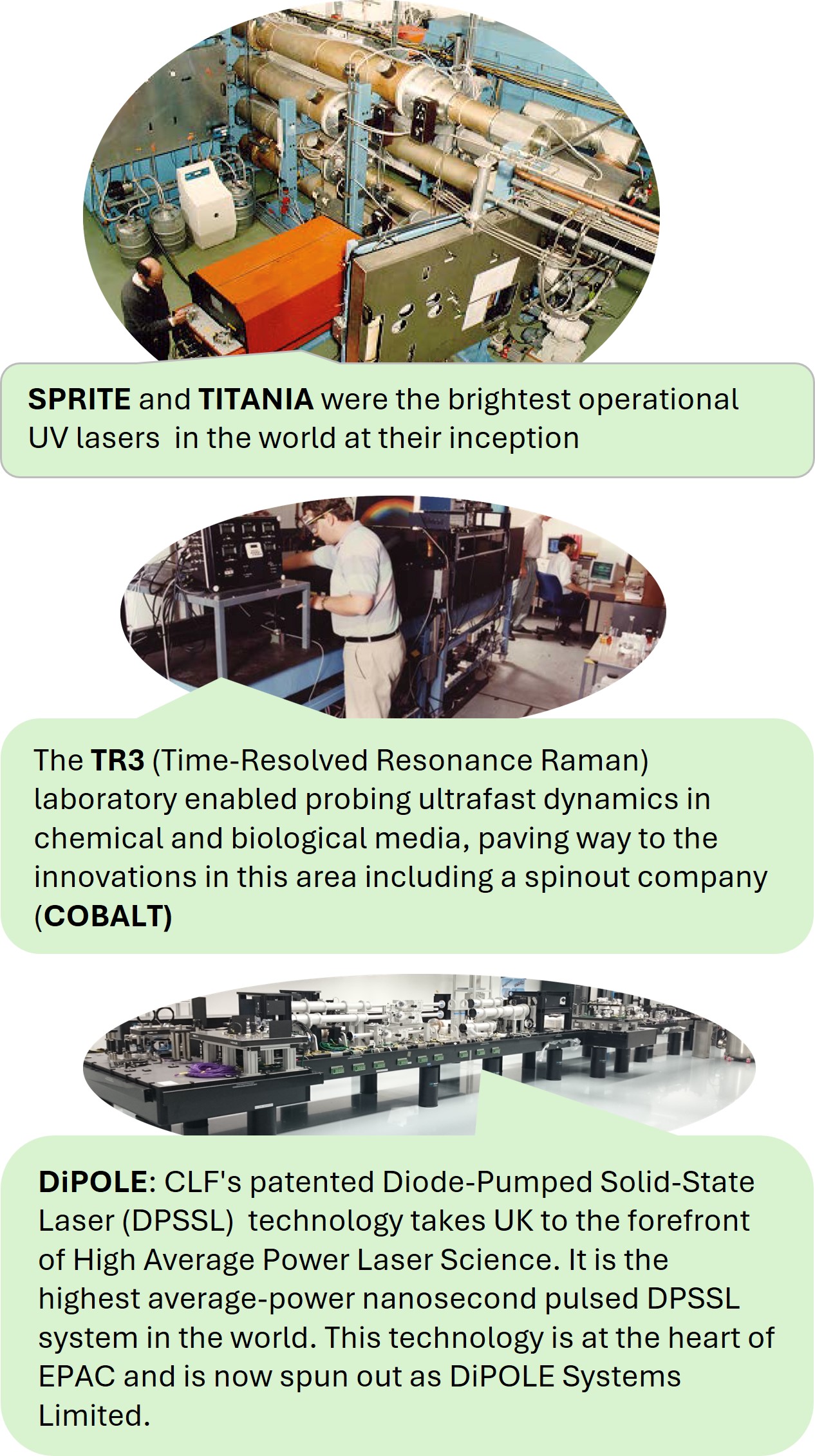
The UK's High-Power Laser Programme began with Vulcan in 1977, establishing the UK's leadership in strategically important high energy density (HED) science. Soon after, CLF launched a high-power UV laser programme with its electron-beam laser facility, ELF, later upgraded to Sprite and Titania, enabling early UK studies of laser‑driven fusion. These facilities were decommissioned in 1999.
In 1982, CLF initiated a strategically important programme combining its laser expertise with the UK's strengths in chemistry and biology. This started with the Ultra-Violet Radiation Facility (UVRF) for DNA‑damage studies, as well as nanosecond and picosecond laser and X‑ray labs – a unique capability beyond university scale. The EPSRC‑funded PIRATE project established a major UK laser‑spectroscopy capability and paved the way for Ultra (2008), a world‑class time‑resolved spectroscopy facility for understanding chemical reaction dynamics.
As new facilities emerge, older ones are carefully retired. CLF is currently building HiLUX, a globally unique facility funded by UKRI that will transform ultrafast device physics, chemistry, biomedical diagnostics, industrial biotechnology, drug discovery, advanced materials, quantum technologies, catalysis, batteries and energy research. Ultra will be sunset when HiLUX becomes operational.
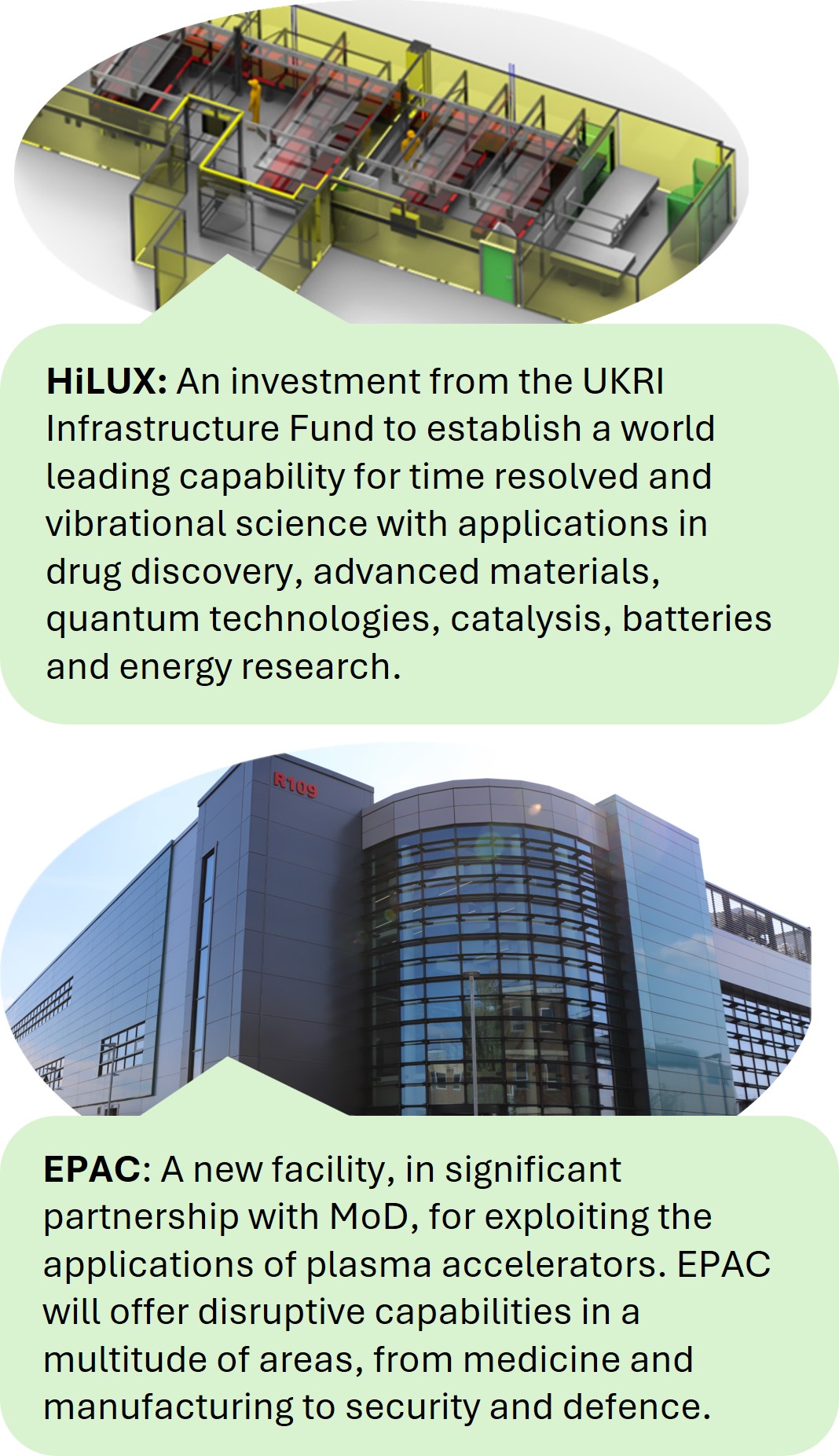
Astra was the UK's first femtosecond high‑power laser, leveraging the Nobel Prize‑winning CPA technique. It enabled pioneering ultrafast photophysics and photochemistry studies, as well as seminal breakthroughs in laser‑driven plasma accelerators, which were then advanced by Gemini. Gemini was the world's first dual‑beam petawatt laser facility, opening pathways for applications of plasma accelerators and the exploration of extreme fundamental physics. Its success paved the way for EPAC, enabled by another CLF innovation – DiPOLE technology. Gemini will be decommissioned when EPAC becomes operational in 2027.
 Astra also enabled ultrafast XUV science, eventually forming the Artemis facility. Artemis provides world‑leading capability for probing ultrafast dynamics in matter with attosecond XUV pulses – critical for emerging Quantum Technologies. It will be combined with HiLUX in 2028, unlocking unique capabilities for energy research and quantum science.
The CLF pioneered another breakthrough technology – OPCPA – which enabled the 2002 upgrade of Vulcan to Vulcan Petawatt, the world's first open‑access petawatt laser. Vulcan maintained global leadership for many years before being decommissioned in 2024 to make way for Vulcan 20‑20, which will be one of the most intense lasers ever constructed, opening unexplored regimes in QED and laboratory astrophysics, while providing sovereign capabilities for the MoD and the UK fusion programme.
The Octopus facility – STFC's only life‑science imaging facility – grew out of early biological‑damage studies. Using state‑of‑the‑art microscopes and multicolour lasers, it images biological systems in real time and tracks molecular interactions such as protein–protein communication. Octopus is uniquely world‑leading due to the combination of bespoke laser technologies with STFC expertise in micro/nano‑fabrication, data science and AI/ML. Recent investments in cryo‑SIL and correlative imaging have made Octopus Europe's pre-eminent bio‑imaging capability, driving breakthroughs in cancer research from cellular to organism scale.