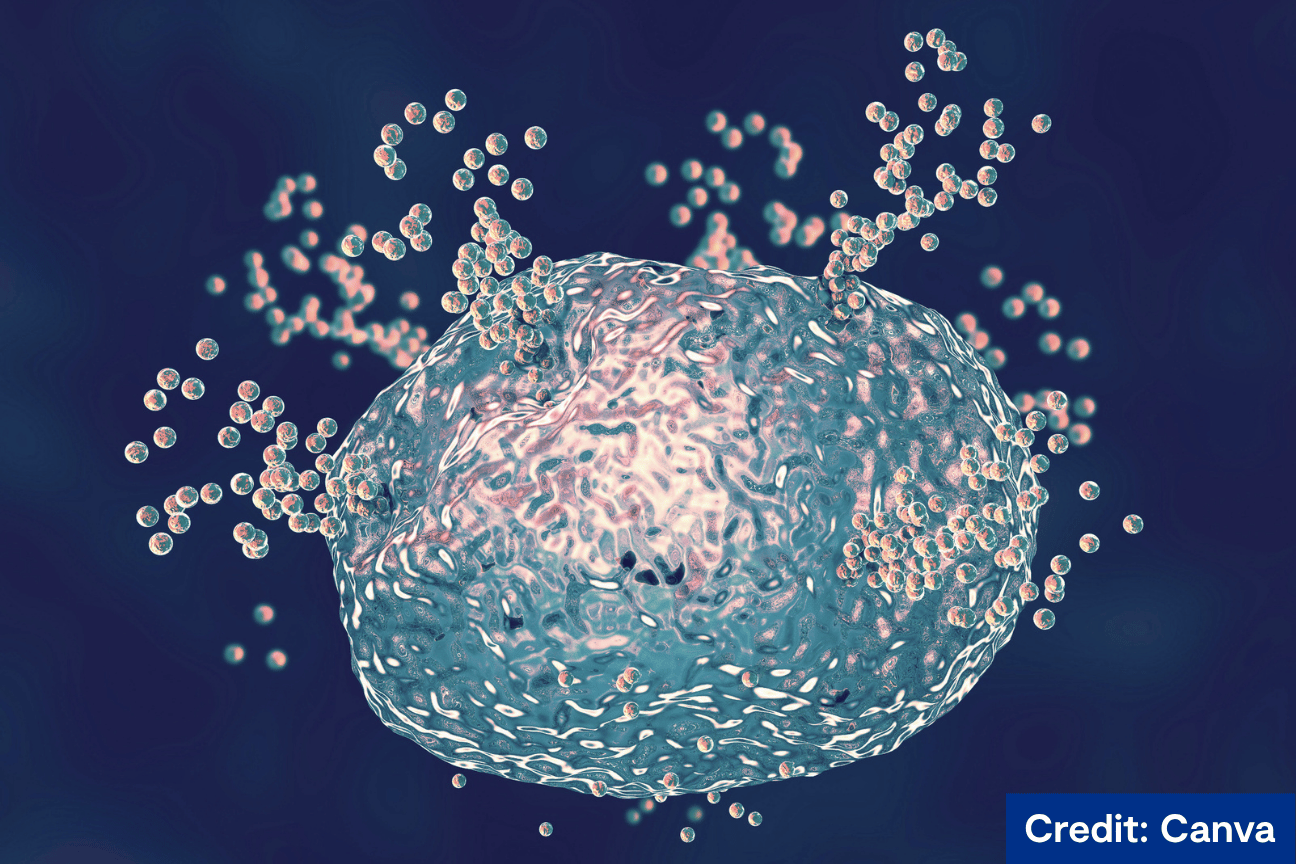
Representation of extracellular vesicles. Credit: Canva
A recent collaboration between University of Kent scientists and the Central Laser Facility (CLF) has affirmed the remarkable versatility of the technology in expanding the possibilities of protein production.
The Vesicle Nucleating Peptide (VNp) technology, which underpins Kent spin-out company Sirius Proteins, dramatically increases the yield, simplicity and scope of recombinant protein production in bacteria, making it easier and more affordable to produce more complex proteins for use in early stage research, drug development, diagnostics, food production and environmental management.
Hormone treatments, vaccines and even some washing powders contain recombinant proteins produced by bacteria genetically modified to 'manufacture' them. However, many of these proteins remain difficult or expensive to produce because they are unstable, toxic to the bacterial cells that manufacture them, or require complex folding to remain functional.
The VNp technology developed by Prof Dan Mulvhill and his lab in the School of Natural Sciences solves these challenges by directing the bacterial cells to 'package' the recombinant proteins they create into membrane-bound vesicles and export them from the cell. This vastly increases the production of many useful proteins while simplifying their purification, improving their stability and reducing downstream processing, ultimately making the process more efficient.
The lab's latest collaboration with Professors Lin Wang and Stanley Botchway at the CLF's Lasers for Science Facility (LSF), led by then Kent PhD student Dr Bree Streather, used the world leading advanced quantitative imaging techniques developed at the LSF's Octopus imaging cluster to understand the structure and properties of the recombinant vesicles produced by the VNp-engineered bacteria. The findings, published in high-impact-factor Journal of Extracellular Vesicles, suggest that the technology is more versatile than first thought.
Dr Streather said: "When we compared naturally-occurring vesicles with those produced by the VNp-engineered bacteria, we found that the latter were much stronger in composition and functionality, affirming that this technology is capable of supporting extracellular vesicle engineering, targeted protein delivery and future therapeutic development.
"This is particularly useful for the production of insoluble proteins, such as insulin, which would otherwise clump together in the cell, or proteins that are toxic to bacteria which would destroy the cell before we could isolate them. By delivering these proteins intact to the outside of the cell, or even to their therapeutic target, the vesicles make the process of recombinant protein production and delivery much simpler and more effective, which could speed up drug production and improve efficiency. This in turn could help reduce blockages in the medical supply system and make drugs cheaper in the long-run."
Prof Dan Mulvihill, Professor of Cell and Molecular Biology, said: "We couldn't have got this far without the Lasers for Science - CLF. The techniques we've developed with their team have enabled us to demonstrate VNp's applications in high-throughput protein engineering, screening and drug discovery workflows, as well as production of functional monoclonal antibodies suitable for research, diagnostic and therapeutic applications. Showing that we can actually use the technology to control the composition and functionality of vesicles was the obvious next step.
"Collectively, our studies have transformed VNp from a serendipitous biological observation into a versatile biotechnology platform with clear commercial relevance. It's exciting because it gives us the capability to make protein production much cheaper for both industry and fellow researchers – essentially democratising protein production and paving the way for more affordable research and healthcare solutions, as well as expanding opportunities in other sectors."
Prof Stan Botchway from the Lasers for Science (LSF) Central Laser Facility, said: "This is an excellent example of using our advanced microscopy techniques developed at a world leading National Facility to help both basic research as well as a new spin-out company to accelerate their product development. The central challenge here is, how to move EVs from biological discovery to bioengineering to industrial protein production and clinical applications, and this is where the LSF is playing a significant role. This is such a fun research project to work on and I look forward to helping the team and company to grow. Moreover, this is a market valued at approximately $229 million to $1.74 billion with accelerated growth projection."
Prof Dan Mulvihill and the University of Kent are now in the process of creating a spin-out company, Sirius Proteins, to commercialise this patented technology, which is also being made freely available to non-profit organisations and research institutes.
The project was led by Dr Bree Streather during her Biotechnology and Biological Sciences Research Council-funded PhD in the laboratory of Prof Dan Mulvihill at the University of Kent. The project brought together expertise in protein engineering, advanced microscopy, biophysical characterisation and cryo-electron microscopy through a collaboration between the University of Kent, the STFC-supported Lasers for Science Central Laser Facility (CLF), Leiden University, and academic and industrial partners.
The pioneering Vesicle Nucleating Peptide technology was first developed in 2023 in partnership with FUJIFILM Diosynth Biotechnologies, with funding from the Biotechnology and Biological Sciences Research Council (BBSRC).