Photoelectron and photo-ion spectroscopy on molecules in the gas phase
The DynAMO (Dynamics of Atomic, Molecular and Optical) end-station on Artemis is dedicated to studies of molecular dynamics in the gas phase. The DynAMO end-station has a source chamber and main spectrometer chamber with three molecular sources (CW gas-jet, effusive and laser desorption) and two spectroscopy techniques (dual photoelectron and photo-ion coincidence and photoelectron time-of-flight). The DynAMO end-station specialises in pump-probe experiments with a temporal resolution of <50 fs. Pump pulses are tuneable from 190 to 2000 nm, and XUV probes from 15 to 8 0eV are available.
Photoelectron-photoion coincidence spectroscopy
Photoelectron-photoion coincidence spectroscopy (PEPICO) is the flagship technique of the DynAMO end-station. By using a dual velocity map imaging spectrometer, DynAMO can record all photoelectrons and photoions generated from a single laser shot. By correlating the momentum vectors of all charged particles, it is possible to filter photoelectrons to specific ion mass-to-charge ratios, and their momentum, to provide photoelectron spectra free of any background or to correlate other ions produced in the same events as the selection ion. These spectra provide unique fingerprints to identify chemical isomers and photoproducts that are produced during the photochemical reaction.
The PEPICO system on DynAMO comprises a dual velocity-map imaging (VMI) stack with two 100 mm active area delay line detectors (Roentdek Hex100). PEPICO can be combined with the effusive or CW jet molecular sources.
The PEPICO system utilises the Artemis Light Conversion laser system. We can provide pump wavelengths between 190 and 2000 nm, and probe wavelengths between 15 and 80 eV at a repetition rate of 100 kHz.
Time-of-flight photoelectron spectroscopy
Photoelectron spectroscopy provides a unique fingerprint of electronic structure of molecules. The time-of-flight (ToF) spectrometer on the Artemis DynAMO end-station is a designed to have a reduced noise floor, minimising scattered UV light typically associated with short wavelength deep-ultraviolet (DUV) optical pumps. DynAMO provides an angle resolved spectrometer with up to three electron ToF (eToF) spectrometers, two vertical and one horizontal, for simultaneous collection of perpendicular photoelectron ejection angles. These provide angular distribution information, and the ability to focus on separate kinetic energy regions simultaneously.
The eToF system on DynAMO has a horizontal Kaisdorf ToF and two vertical home-built eToFs. eToFs can be combined with the effusive or CW jet molecular sources. The eToF system uses the Light Conversion 100 kHz laser system. We can provide pump wavelengths between 190 and 2000 nm, and probe wavelengths between 15 and 80 eV.
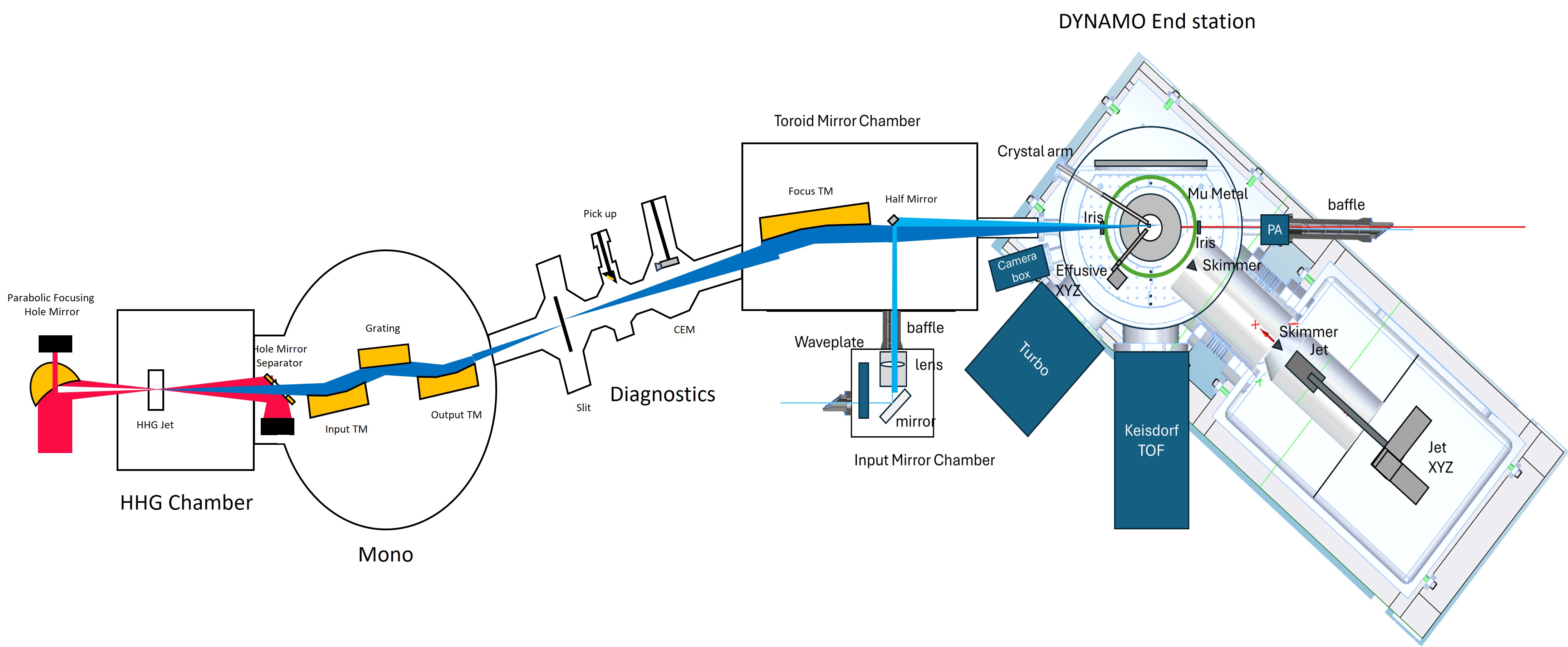
Schematic of the DynAMO end-station on its XUV beamline. From left: XUV pulses are generated through high harmonic generation (HHG). A single harmonic is then isolated from the HHG comb using a monochromator, and focused into the DynAMO end-station using a grazing incidence toroid. Tunable pump laser pulses enter through the input mirror chamber and are dent into DynAMo ata small angle to the XUV pulses.