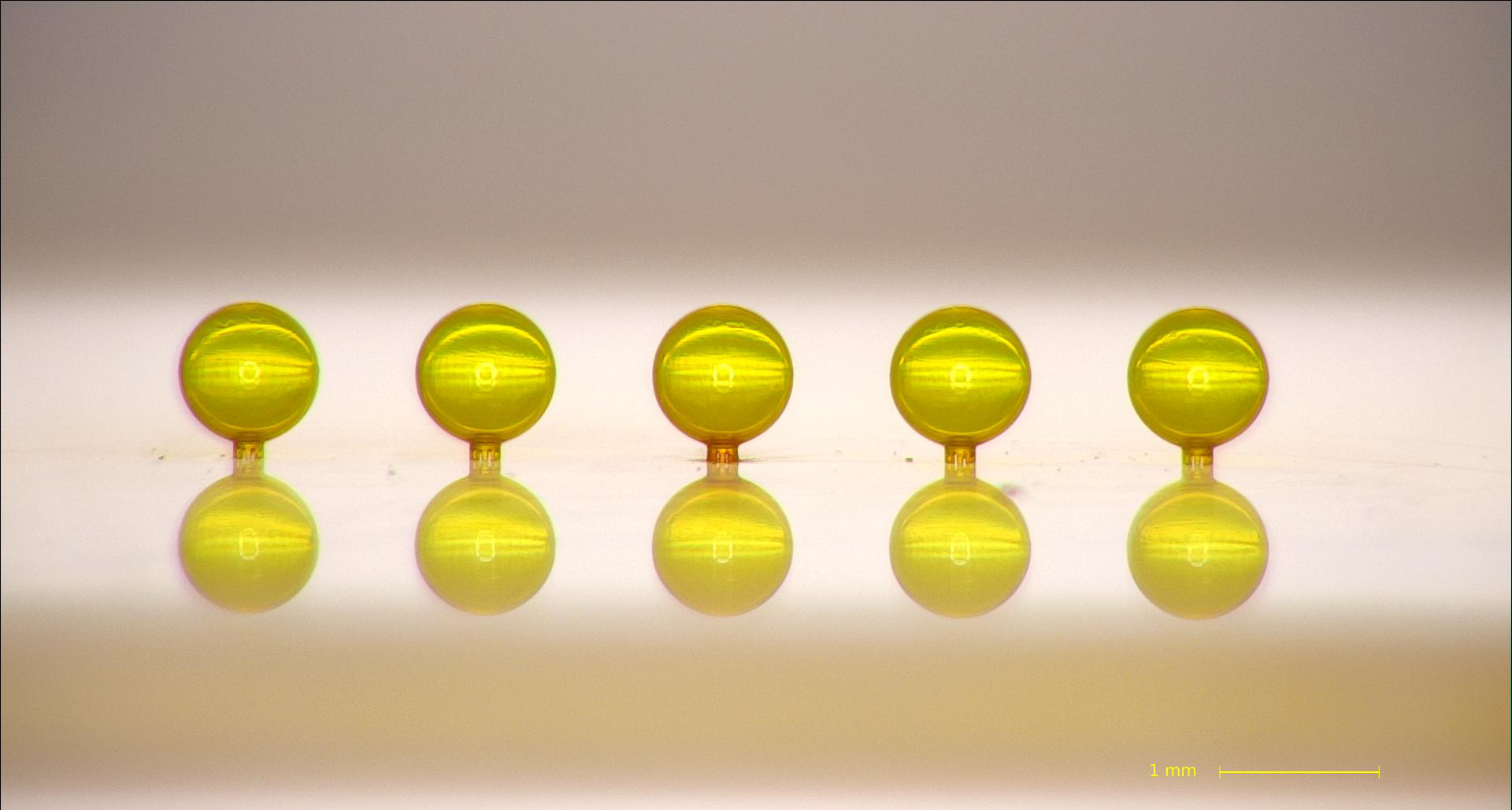
Prototype plastic shells for use in inertial fusion experiments. The shells were 3D-printed by the Central Laser Facility's target fabrication team. They are 900μm across, with a 30μm wall thickness and a 150μm-diameter tube for support during printing and for resin drainage. Developers aim to make the tube around 2-5% its current diameter, where it will function as a port for filling the shell with fuel. Credit: CLF
COST Actions are four-year grants from the European Union that are designed to help scientists and students travel abroad and develop their research. The new project is called “ICED” and is focused on developing a supply chain for cryogenic fusion targets.
The need for targetry development
The National Ignition Facility in the USA achieved a major scientific breakthrough in 2022, when laser beams were used to implode a millimetre-sized pellet of hydrogen fuel that generated 3.15MJ of fusion energy - more than the 2.1MJ of laser light used to drive the implosion.
Achieving this milestone required more than a decade of research and hundreds of laser shots on exquisitely manufactured, cryogenically-cooled, spherical targets. The target that achieved the ignition breakthrough was a 2mm-diameter sphere of diamond whose outer surface was polished smoother than a mirror. The inner surface of the diamond was coated in an almost perfectly uniform, sub-millimetre layer of solid Deuterium / Tritium (DT) ice and the remaining space was filled with DT vapour. It is thought the laser targets used in a future fusion power plant will be simpler and (far) cheaper, but will need to be manufactured to a similar level of precision.
Europe currently has two major laser facilities that are capable of conducting implosion experiments – Orion in the UK and Laser MégaJoule in France. Of these, only Laser MégaJoule plans to manufacture and shoot small batches of cryogenic targets. If European fusion research is to progress within the next ten years, we will need to shoot hundreds of cryogenic targets. Looking further ahead, a working fusion power plant may consume targets at a rate of one or more times a second. If laser fusion energy is to be economically viable, the targets must be cheap and abundant.
Our aims
The two main aims of the ICED Cost Action are to establish a network of target fabricators across Europe and to map out a supply chain for cryogenic inertial fusion targets. It puts a particular emphasis on supporting younger researchers in the field of laser targetry, who are surpassingly rare and who possess the specialist skills that will be crucial in the development of a power plant. Money from the Action will be put towards annual conferences and a 2027 winter school. It will also provide support for individuals to conduct experiments and collaborate with foreign laboratories.
The CLF already directs significant resources towards improving laser target manufacture through its world-renowned target fabrication team and the UPLiFT project (UK Programme of Laser Inertial Fusion Technology for energy). It is hoped that the ICED Cost Action will make a useful contribution to this wider effort.
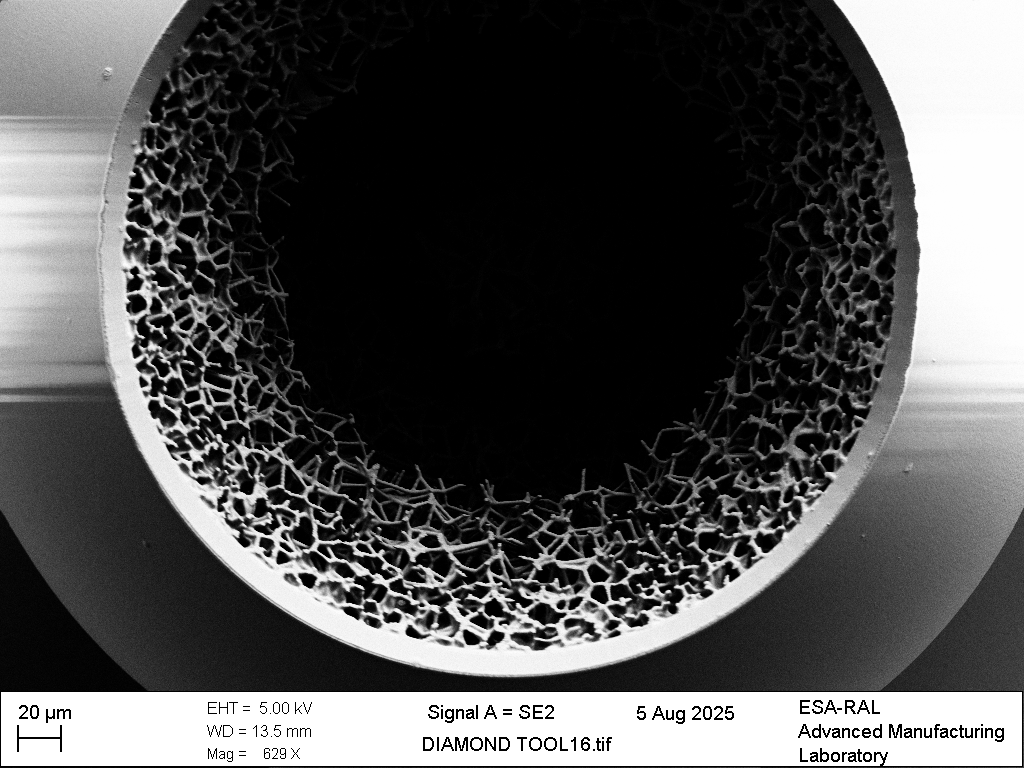
Interior view of a prototype foam-filled fusion target. The image is conical cutaway of a spherical shell with a foam internal structure, generated using a scanning electron microscope. The target is made from plastic and 3D-printed as one piece, ready for fusion fuel to be inserted at a later stage.. Credit: CLF
Collaborators
Special thanks go to those researchers who have already volunteered to contribute towards the Action goals (Hamad Ahmed, Sam Irving, Matthew Khan and Chris Spindloe), and thank you also to Robbie Scott and the CLF directorate for their support.The Action will be managed over the next four years by a committee of representatives from across Europe, led by the Action Chair Michael Ehret.
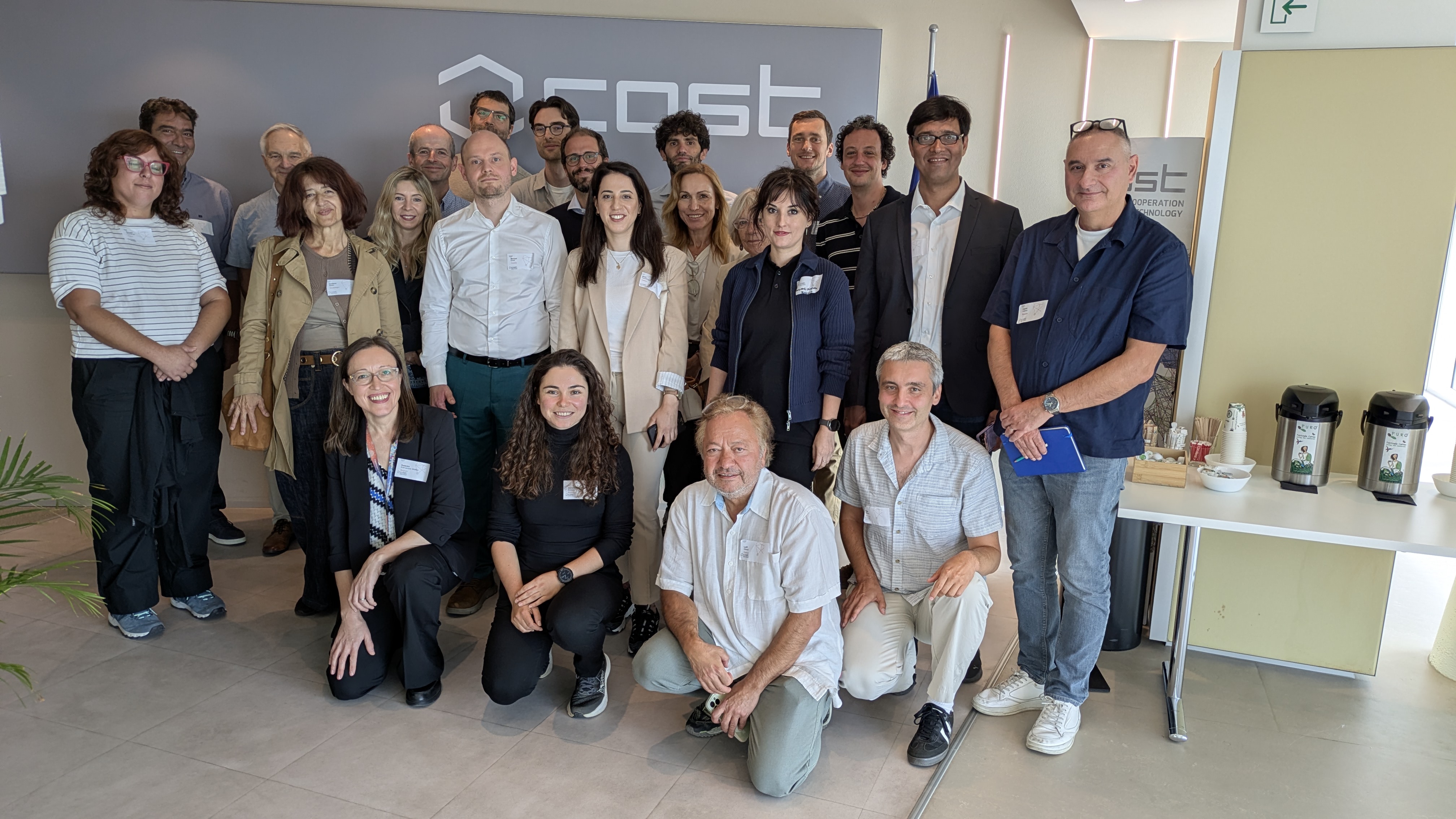
Members of the "ICED" Cost Action on inertial fusion target manufacture, representing 12 of the 15 countries currently associated with the project. Photo taken at the kick-off meeting in Brussels on 9 September 2026.
If you would like further information about the COST Action, about conditions on funding, or if you would like to be formally involved, please contact:
The Vice Chair of the Action: Philip Bradford (email: philip.bradford@stfc.ac.uk)
Or visit the Action page on the COST website: Action CA25144 - COST