Project summary
Quantum materials are substances whose electrons behave in odd ways that ordinary physics cannot explain. They are leading candidates for the next generation of computing, sensors and data storage, and even for solar energy harvesting. This is why quantum technologies feature in HM government's Modern Industrial Strategy.
Studying quantum materials means watching electrons move over timescales shorter than a trillionth of a second. The Artemis spectroscopy facility, at the CLF Lasers for Science Facility, is one of only a handful of laboratories worldwide able to do this. However, our latest developments are so good that just one experiment produces millions of measurements. This is far more than our team can examine using traditional data processing, and it is important not to miss any discoveries hidden in the data.
A team from Aarhus University in Denmark came to Artemis to address this challenge using AI. They trained software to sort the entire dataset automatically and find patterns without being given prior knowledge. They applied AI to data from three quantum materials in succession: collectively, these three studies develop the method, establish its reliability, and test a contested scientific claim.
Key challenge
The findings that matter in quantum materials are often small, subtle effects that emerge only through careful measurement and detailed analysis. A marginally slower response in one corner of a dataset can constitute the entire discovery. Selecting data by hand therefore carries real risk: genuine effects may be overlooked, and spurious ones occasionally reported.
However, AI is only as trustworthy as the checks placed upon it. Before relying on the method for new science, the team had to establish precisely where it worked and where it could mislead — a rigorous approach not always applied when AI enters research.
Project approach
At Artemis, researchers used laser pulses to excite a quantum material and ultraviolet flashes to capture images of electrons in motion. The AI was then used to sort the resulting data into groups with similar behaviour.
Two capabilities make Artemis distinctive. Firstly, it is possible to continuously tune the colour of its ultraviolet flashes, allowing scientists to see inside a quantum material in three dimensions rather than in a single plane. Secondly, it houses two complementary electron “cameras" in one chamber: one surveying the whole picture, the other resolving fine detail. Very few facilities anywhere offer either capability, and fewer still offer both.
Benefits of the work
AI and quantum technologies both sit within Digital and Technologies and Advanced Manufacturing, two of the eight priority sectors in HM government's Modern Industrial Strategy. Artemis provides a location in which the underpinning science can be done, long before any commercial application appears in these areas. For example, even though one of our studies disproved a widely reported claim about a quantum material, these negative results can help focus more time on new materials early in the development cycle. The method, the data and the code resulting from the work have been published so laboratories worldwide can now apply AI to vast scientific datasets using an approach developed and validated in the UK.
Key quote from the papers
"Overall, our results call attention to important subtleties in the interpretation of pump-probe ARPES data, and demonstrate how the application of machine learning to large data sets can reveal underlying trends that might otherwise remain unnoticed."
— Meyer et al., Electronic Structure 7, 045001 (2025), Conclusion.
PowerPoint summary
Quantum materials may power the next generation of computers and sensors, but studying them now generates millions of measurements — more than researchers can examine using traditional data processing. At the Artemis spectroscopy facility in Harwell, one of only a handful of such facilities worldwide, a team used AI to analyse the full dataset, and disproved a widely reported claim for one of the materials in the process. The method has been published for other laboratories to use. AI and quantum technologies are both priorities in HM government's Modern Industrial Strategy, and Artemis is one of the few places where the groundwork for these areas can be done.
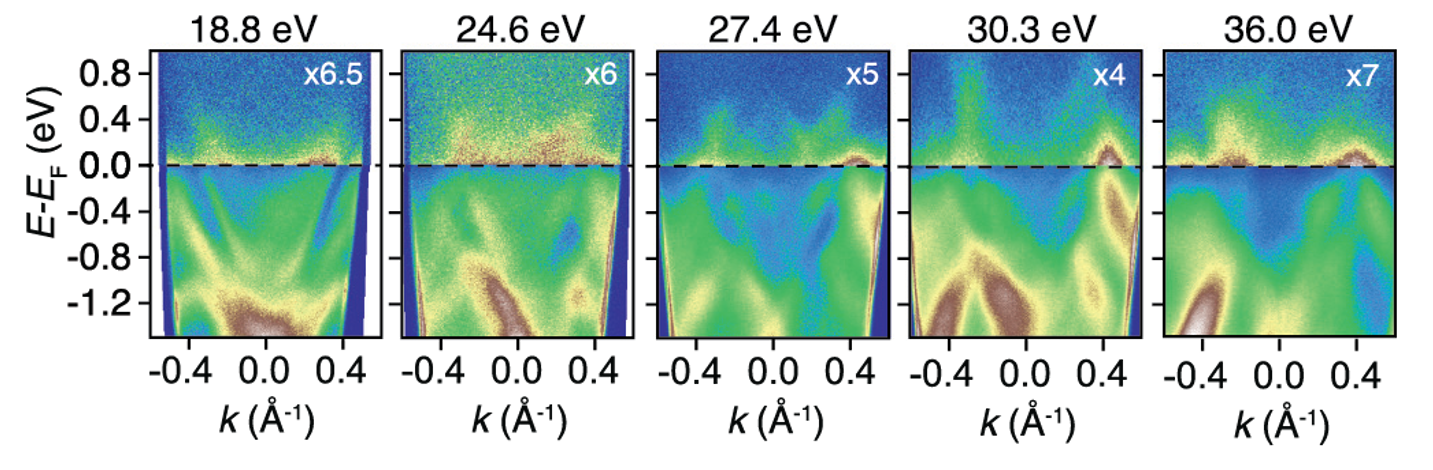 Electrons in PtBi₂, filmed at five probe energies—a few slices out of a huge dataset in many dimension.
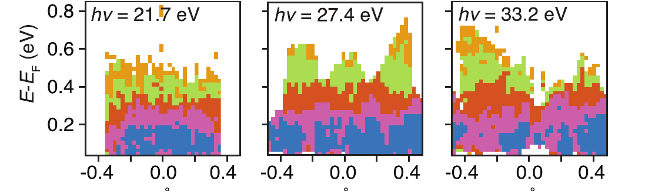
The same data, sorted automatically into regions that behave alike.
Figures: Majchrzak et al., Phys. Rev. Research 7, 013025 (2025), CC BY 4.0.