Project Summary
Using the Artemis facility at the CLF Lasers for Science Facility, researchers have uncovered a new mechanism for controlling magnetism using light. This breakthrough provides important insights that could support the development of next-generation data storage and information-processing technologies.
The rapid growth of Artificial Intelligence (AI) and data-intensive computing is creating demand for faster, more energy-efficient methods of storing and transferring information. Researchers from Freie Universität Berlin, European XFEL and Elettra used the Artemis facility to reveal how laser-driven electron motion simultaneously changes magnetic properties and electronic structure. Artemis provided the unique combination of ultrafast lasers, extreme ultraviolet probes, electron spectroscopy and expertise required for the measurements. The findings establish an important foundation for future spintronic technologies and highlight Artemis as a unique UK capability for ultrafast materials research. The research was funded by the German Research Foundation (DFG) and access to Artemis was supported through Laserlab-Europe.
Challenge
Modern computing increasingly depends on the rapid storage, processing and transfer of information. Future spintronic technologies aim to exploit the magnetic properties of electrons rather than relying solely on their electrical charge. However, the microscopic processes that control magnetism occur within an extremely short timescale, making them exceptionally difficult to observe. Capturing these processes requires specialised facilities that are capable of measuring changes in both electronic structure and magnetism at the same time.
Approach
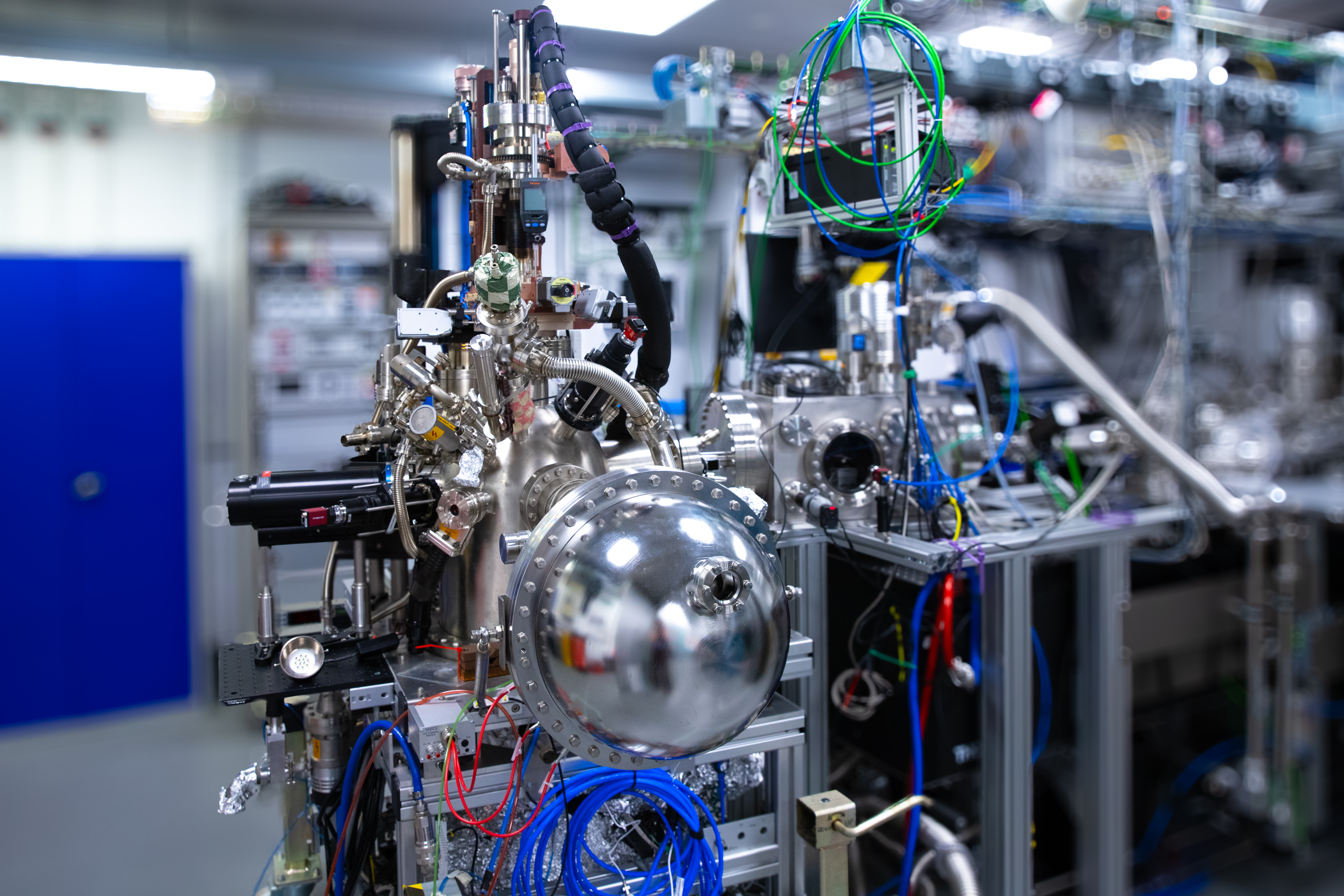
Researchers used the Artemis time- and angle-resolved photoelectron spectroscopy (TR-ARPES) end-station with extreme ultraviolet probe light to track laser-driven electron transfer and its impact on magnetism.
Benefits
The research demonstrated a previously unconfirmed mechanism for controlling magnetism directly with light. It showed that spin-polarised electrons can be transferred between electronic states almost instantaneously, producing measurable changes in both magnetic properties and electronic structure. The work also established temperature as a practical tuning parameter for magnetic switching dynamics, improving understanding of the fundamental limits of magnetic control and informing future high-speed, energy-efficient spintronic technologies.
Quote
"These results demonstrate how ultrafast laser techniques can reveal and control the fundamental interactions between electronic structure and magnetism."
Artemis Facility Team
Powerpoint Summary
Using Artemis, researchers discovered how ultrashort laser pulses can control magnetism at the fastest possible timescales. They directly observed spin-polarised electrons moving between electronic states in gadolinium, producing simultaneous changes in magnetism and electronic structure. The study also showed that temperature can tune magnetic switching dynamics, providing new insights for future spintronic data-storage and computing technologies that will enable faster and more efficient data storage and transfer.
Reference
Bobowski et al., Ultrafast interface spin transfer and its impact on the electronic structure, Science Advances 10, eadn4613 (2024)