Scientists from the UK Health Security Agency (UKHSA) have used the Central Laser Facility (CLF) and ISIS Neutron and Muon Source to investigate the impact of air pollution on public health. The study focused on understanding how particulate matter interacts with the blood-brain barrier (BBB) at the cellular and molecular level.
According to the World Health Organization (WHO), air pollution is associated with around seven million deaths every year. Epidemiological studies have shown links between long-term exposure to air pollution and cardiovascular and respiratory diseases. And, more recently, evidence has suggested a link between air pollution and neurological diseases like Alzheimer's and Parkinson's disease.
Inhaled pollutant particles could have negative effects on the brain, by entering it directly through the blood circulatory system. There is still a critical knowledge gap that persists regarding the specific interactions between different pollutants and the Blood Brain Barrier (BBB) at the molecular level.
In this study, published in Science of The Total Environment, the researchers looked at how pollutant particles interact with the BBB, which is the critical barrier between the blood and central nervous system. The BBB protects the brain from toxins in the blood, but this study shows that it may not be successful at protecting from air pollution particles.
The team employed an interdisciplinary approach, using diesel fuel particle samples and integrating cellular models of cerebral microvascular endotheliocytes to simulate a BBB, then visualising it at the CLF's Octopus facility. The team used advanced light on a confocal microscope and electron microscopy (EM), which can only be done using the CLF's Crossbeam EM machine. Neutron spectrometry was also used at ISIS, with a particular focus on the plasma membrane.
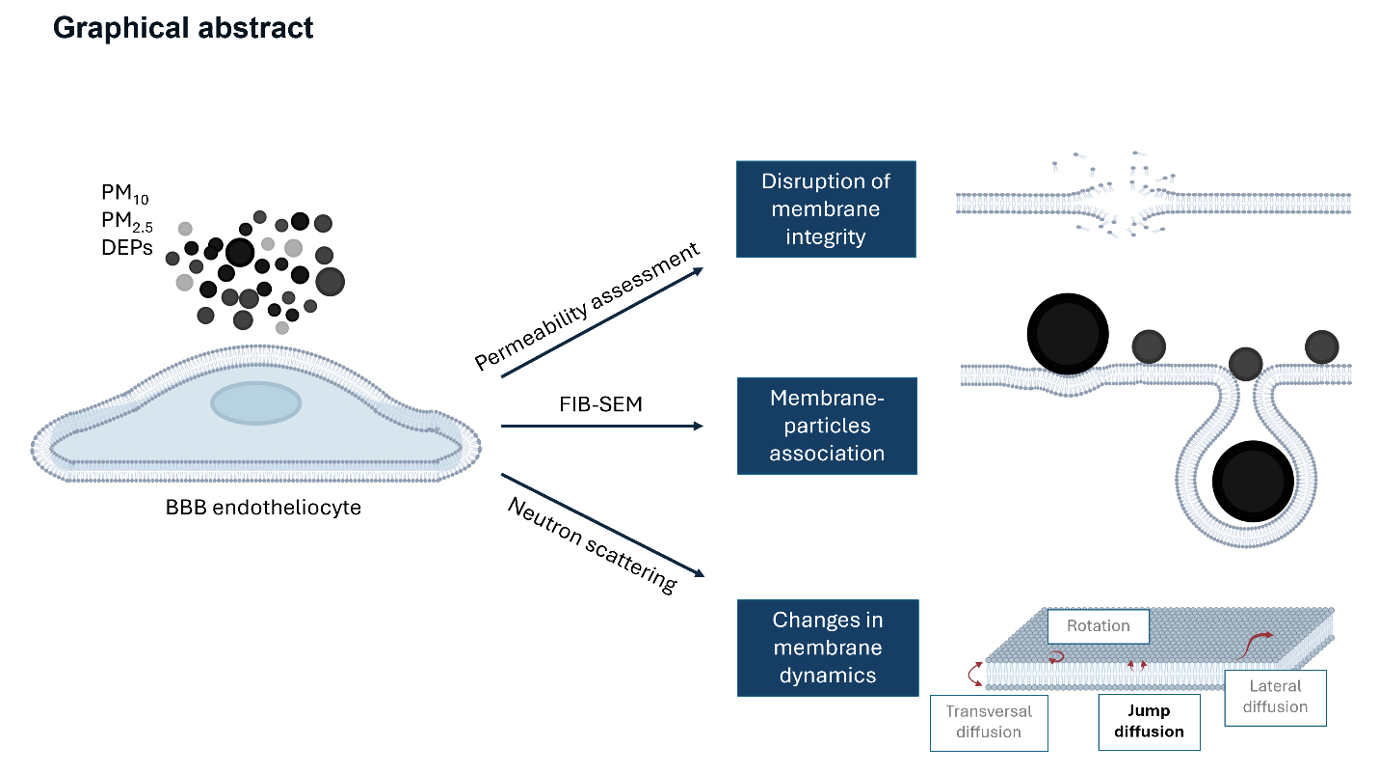
From the graphical abstract of the paper.
Benji Bateman, a link scientist from the CLF's Octopus facility, said,
“We hosted the experiments on our Leica SP8 confocal microscope to visualise the tight junctions and lysosomes using fluorescence markers, effectively marking out a BBB. We then hosted the experiments on our Zeiss Crossbeam to perform volumetric Electron Microscopy (EM), cutting through the sample slice by slice and taking a high-resolution EM image of each slice. This combination of techniques let us see where the diesel particles were in relation to the BBB."
The study's authors said,
“By determining the molecular interactions between the pollutants and the BBB, this research bridges a critical gap between observational studies and fundamental neuroscience, paving the way for a deeper understanding of the neuropathological consequences of air pollution."
With the increasing incidence of debilitating neurological diseases like dementia, research in this area to understand how our environment contribute to their onset will be vital to the development of future treatments.
This study demonstrates how the CLF's advanced suite of microscopy and interdisciplinary collaboration can be used for the direct benefit of improving public health.
Read the paper here.
Link to the original article on the ISIS website.