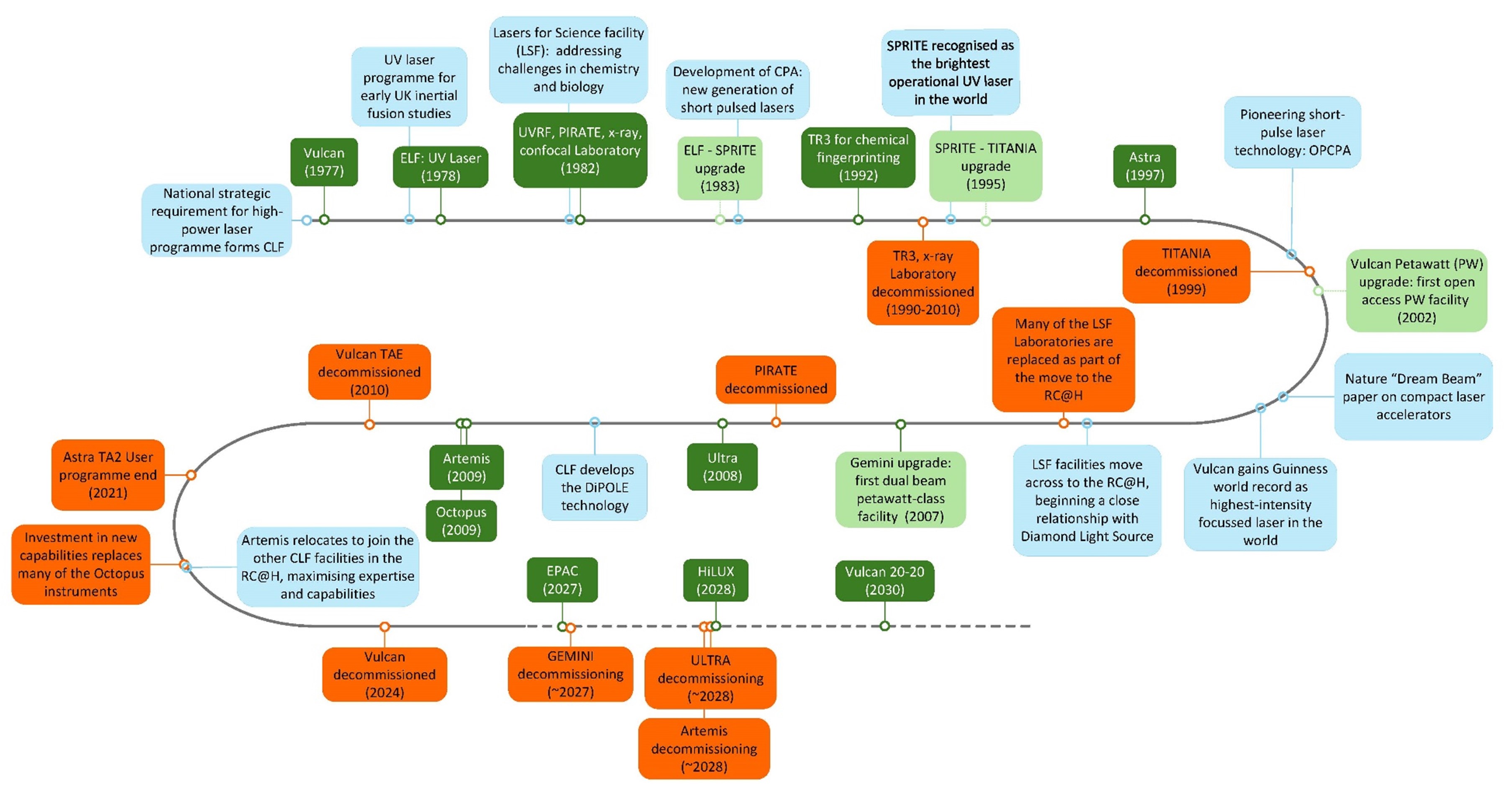
The Central Laser Facility (CLF) dates to 1974, when the UK academic community came together to propose a single, central laser infrastructure that they could share. The argument was that this would enable a more advanced and capable infrastructure for the UK than spending an equivalent sum on lesser capabilities at numerous universities, thereby giving us collectively an international edge. Since that dawn, the CLF has evolved, adding new capabilities in response to changing academic and national priorities, whilst simultaneously sunsetting others to maintain a world leading yet cost-efficient provision for the nation and the taxpayer, always in consultation with our user community.
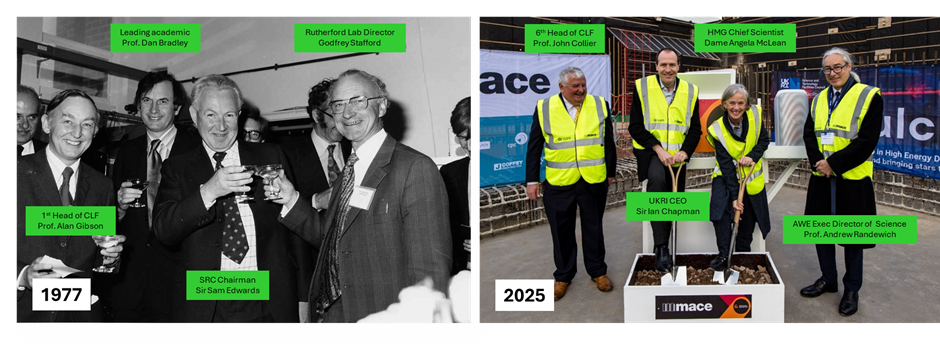
Almost 50 years separate these two photographs, and they are a metaphor for the changes taking place in CLF today. On the left, the occasion of the firing of the first Vulcan laser shot in 1977 in the Vulcan Main Control Room and on the right the groundbreaking for the Vulcan 20-20 Project in 2025 on the site of the demolished Vulcan TAE/TAW
Today, United Kingdom Research and Innovation (UKRI) is investing in the modernisation of the CLF, bringing new, modern, future facing facilities online that are aligned to the UKRI strategic mission whilst simultaneously sunsetting time served CLF infrastructures. Strategic alignment to the Research Councils, either in the form of UKRI as now or its predecessor arrangements have always been a priority in our development, with a consequence that around 70% of academic experiments conducted in CLF are supported by Research Council grants. This approach has also enabled a wide range of timely innovations feeding directly into the economy and the CLF stands out within STFC for its patents, licensing, invention disclosures and spinouts. To gain a better understanding of the CLF’s impact, reputation and global reach in the last decade, a socio-economic impact study was conducted by an external specialist company.
Current Strategic Investments
The advent of UKRI has provided a step change in opportunity to completely transform much of CLF's aging infrastructure, positioning the UK with pioneering and forward-facing capabilities for the coming decades. This enables a scientific leap forward for the academic community, as well as incorporating greater capacity to meet the increasing needs of industry and other agencies of the state. These investments are well aligned to UKRI's new funding model, enabling a balance of curiosity driven research, impact on HMG's Industrial Strategy including defence and national security and support for the growth of companies and industry.
With partners, UKRI is investing in several projects below - there are further details elsewhere on this website. In keeping with our historical approach to delivery efficiency, these new investments are accompanied by the identified sunsetting of existing time served capabilities. An overview of the changes underway and coming in the next few years can be found by clicking the thumbnails at the bottom of this page.
Across five decades, CLF has combined innovation, strategic investment, and responsible facility sunsetting to maintain sustainable world leadership in laser-based science, as illustrated below. Please click the image for more details on the CLF's history and ongoing evolution.